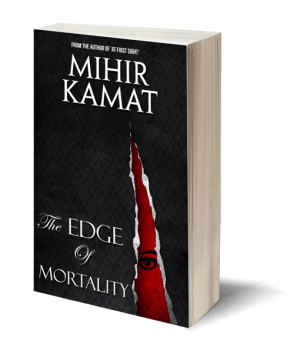
Tag: thriller

  • The Edge of Mortality – now accepting pre orders!

    Greetings!

    I’m very excited to announce that my next book, The Edge of Mortality, is now accepting pre orders on Inkshares. Inkshares is a crowd funding platform that allows me to pitch my book to hundreds of potential readers, who may pledge support for a particular project if they like what they see. Read more about their model here.

    Dear readers, I’m asking for your support in any way you can. The book is half way done and your support will (quite literally) decide if this book lives or dies. A quick like or share on social media would go a long way in getting the word out, and if you’d like to go the extra mile, I’d be extremely grateful for that precious pre order. You can read and follow the story so far and pre order on the project site. The site will be refreshed regularly with additional chapters and project updates. Pledges will also have access to the manuscript in advance and be able to participate in the book’s success story!

    I am proud of our journey so far and hope your support will bring this book to fruition. Your feedback is always welcome.

    Happy reading!

  • Writing that perfect beginning

    I’ll let you in on a little secret. There is no spoon. *dodges bullets*

    For folks who did not get the obscure Matrix reference, don’t fret. For those who did, *high five*.

    As human beings, all of us have stories to tell. Stories are born when our inherent creativity meets a general happening that we observe, experience or simply choose to believe in. And everyone likes a good story. *bangs desk to make a point*

    As writers, we have the important job of being able to tell a good story. If you’ve been doing this a while, you would know that a good story is one that triggers a certain note with your reader; it could be a particular emotion, or a shared experience, or simply a bit of humor that makes them laugh at the end of a very tough and frustrating day.

    It helps if you start well, and keep the pace of the story rolling once you have your reader hooked. I’ve been troubled a few times when it came to starting a new short story or book. Sometimes, the original beginning felt a bit too cheesy. Or the first line was too verbose, with a lot of unnecessary rambling. Or what I read seemed so mundane that I preferred to wash the dishes rather than write some more.

    WHY IS THE BEGINNING IMPORTANT?

    The first line, first page, first chapter, is what draws the reader towards your book. There are millions of books available in the market, all competing for the same real estate: your reader’s attention. If you believe some of the polls making the rounds on the internet *clicks button*, they found that the average number of book readers across the world was slowly declining. Some also reported that the amount of “garbage” available on the internet was increasing exponentially, thanks to halfhearted writing, lack of editing, and the availability of trigger happy self-publishing. Don’t get me wrong, there are some really great self-published books out there, but they seem to be buried under the sheer millions of distressing, unpolished manuscripts.

    So how do I, as a reader, decide if I want to pick up a certain book or not? I’d see the cover first, and seem to like the art work, with the colors and fonts resonating with my sensibilities. I read the blurb, and the story line seems interesting, but not interesting enough for me to take out my credit card and shell out the $10.99 for the book. The next option available is to simply open the book and start reading, and then decide after reading the first page or two pages whether or not the book is worth my time. If you’re buying the book online, most vendors allow you to view a certain percentage of the book online.

    The first two pages of your story decide your book’s fate: whether it would spend its days in the gentle and loving hands of your awesome readers, or many a cold night on the lonely store book shelf with the others, waiting to be picked and loved *wipes off a tear*.

    In my reading experience, the first paragraph is usually the one that seals the deal.

    There are no right answers when it comes to writing that perfect beginning. Here are some thoughts on how to get started, with well, you know, getting started. *shows pearly whites*

    KNOW YOUR GENRE

    The genre could decide a lot about how your beginning would look like. Thrillers or mysteries could begin with a single short sentence, intended to catch the reader’s attention (I AM SHERLOCK, MASTER OF YOUR MIND). For non-fiction books, it could begin with a simple statement of fact (THE SUN RISES IN THE EAST, AND TODAY WAS THE DAY WHY IT ALL MATTERED). The first line sets the pace for the first page, and so on.

    DON’T REVEAL TOO MUCH, OR TOO LITTLE

    When writing short stories, some writers lose the plot very early and reveal their subject or motives right in the beginning, making for a very bland story. Think of your story as a wrapped gift box; the reader shouldn’t know what’s inside until they slowly unravel the wrapping paper. It could be a ball, a painting, a book, a water gun. If you didn’t take the trouble to find a box, and your gift is shaped like a ball, bounces like a ball; they know it’s a ball, and there’s no fun in unwrapping the gift, no matter how shiny the paper is *ooh, so shiny*. The first paragraph may introduce the subject of your story, but don’t let the cat out of the bag right at the beginning. Your story needs to unfold slowly, as open as possible at the beginning, but crisp and catchy like a shiny paper.

    GET WRITING

    You can’t visualize a great beginning on thin air. Make an outline on paper. Fill in the words. Write or type them out. Polish them a bit. Then edit the crap out of them. Sleep on it, or watch some TV. Then edit again. Rinse and repeat. Sometimes, what started as the beginning looks better somewhere in the middle, and another idea makes it to the top of your outline.

    READ, READ, AND THEN READ SOME MORE

    There are some great writers out there who have mastered the problem of great beginnings. Pick up any one of your favorite books and see what the author did right. Pick up a book you put down before and see the difference. Why did you like the first one and not the second? Make notes on what pulled you in, what put you off, and what kept you engaged. Done properly over time, this simple exercise should help you improve your own storytelling.

    What are some of your techniques to craft that great beginning? Leave a comment.

  • Clean Slate: A work in progress

    I was digging through some of my old pieces and came across an idea that I’d shelved for a while. I spent some time today cleaning up the old piece and wrote up a sample chapter based on the idea I had, a book loosely titled ‘Clean Slate’. I’m sharing it here, would appreciate feedback.

    Do you think I can turn this into a decent book?

    Clean Slate: Chapter One

    It was half past eight on a cold January morning, also incidentally the very first morning of the New Year. The days were beginning to grow, only slightly, so it was still dark out. Most inhabitants of the city of Franklin were still sleeping, what with the chill air and the exhaustion that followed their previous night’s revelry, coupled with the overuse of bottled spirits. But not the boys at The Hallford, they’d been up at the crack of dawn, getting their act together, ready to serve their first waking customers.

    The Hallford was less of a hotel and more of a riverside inn, a property well-kept and fairly luxurious for someone on a medium-sized budget looking for a place to stay. Originally an old mansion owned by a wealthy loner with no living heirs, The Hallford had quite the sprawling lawns and cobblestone driveways, some of which were now freshly black-capped and painted to offer for parking space. The recently painted ochre exterior gave the house a golden glow every time the evening lights came on. The property boasted a riverside deck that afforded its patrons a great view of the Red river and ample opportunities for fishing and sunbathing. And the excellent connectivity via the newly extended interstate highway, the spine that connected the lazy suburbs to the bustling business district, which ran along the east side of the estate, made it the premiere destination for fishing enthusiasts, visiting families, or for putting up uninvited guests.

    The desk manager was an old geezer named Harold Fox, affectionately known as ‘Dirty Harry’, not because of any relevance to the classic film but for the ungodly odor he emanated. He sat at the front desk, dressed in an ancient black coat and wearing inside a dull white shirt on black corduroy pants, slowly sipping on his morning cup of black coffee, adjusting his possibly antique spectacles while trying to read the Dispatch. One could only guess he’d dressed that way every single day of his life since he started there. His full head of white hair was neatly oiled and parted to one side, giving his wrinkly weathered face a spiffy look. The mornings were usually peaceful, but not today.

    The gaggle of attendants now gathered at the northeast window disturbed his concentration.

    ‘What’s going on, boys?’ He asked, shouting from across the desk.

    ‘Take a look for yourself, Pops’, replied one of the lanky ones.

    He wondered what it was that could possibly keep their tiny adolescent attention spans busy. He remembered the hubbub in the corridors from a few years back when one of their pretty guests had decided to go skinny dipping in the river. God bless her freedom of expression.

    Fox stood up, adjusting the crease of his pants so that everything lined up and held perfectly, and then walked towards the group as fast as his age permitted. He had his glasses on, and he kept them on, for he’d liked to get a better look at the nice-looking nudist, if it were one, for old time’s sake. The walk towards the window seemed like an eternity, what with all his bones grinding and feet flopping, and he felt like a rusty old clock going about its daily struggle to strike twelve and losing. Though if he’d have known beforehand what he was about to see, he’d have asked for more time.

    The cobblestone path leading towards the main riverside deck was in view from the window, and a previously clean walkway was strewn with debris that now occupied about twenty square feet of real estate.

    Fox squinted closely at the center of the rubbish for a better look, and identified that he was looking at the charred remains of something. He was standing at a distance of fifty feet from the water’s edge, and he could only discern a large black lump, dead center, surrounded by long scraps of burnt wood that he reckoned were previously painted blue. The water touching this object was slowly turning black and frothy, as if the lump were an oil barrel slowly losing its contents. The surface of this object was shiny black, like a black garbage bag was sheathing it, but at that distance and given his eyesight, it could have been the oil. The object itself was about five and a half feet long and a foot and a half wide.

    In the unending mass of black, Fox detected a startling hit of gold, close to halfway down. He strained his eyes to see, trying to narrow in on the outlier, and inspected it carefully for a few minutes, until he was certain of what it was. To a very old man, the revelation was overwhelming.

    He gasped for breath, held his chest tightly and desperately tried to sit down. The boys who were standing right behind him scrambled to hold him, make him comfortable and brought him a glass of water. He drank profusely, taking in a number of deep, calming breaths, and then whispered, choosing his next words carefully.

    ‘Call the fuzz. We’ve got a floater.’

    The gold wristwatch that adorned the grotesque, charred corpse had fought the scorching flames and won; valor at the cost of beauty that would never be admired again.

    © Mihir Kamat, 2014. All rights reserved.
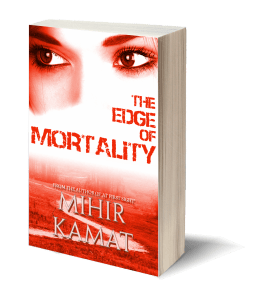
  • The Edge of Mortality – Latest Cover

    Work on The Edge Of Mortality (TEOM) is on in full swing. 4 chapters are complete and another one is in progress.the edge of mortality - cover

    I decided to take a bit of a break with writing this weekend and worked on a brand new new cover design for TEOM. I brought in certain ideas central to the book, and let my creative juices flow while I got more familiar with the image editor. I’m pleased with the results, which I share for my readers, alongside.

    As always, feedback is always welcome.

    TEOM is scheduled for release on July 2014.

  • Coming Soon – The Edge of Mortality

    The Edge of MortalityHaving been struck by a bout of inspiration, I’ve been throwing around ideas for my next book. I seem to be gravitating towards the idea of writing a brilliant thriller, loosely titled – The Edge of Mortality. Below is a sneak peek of what the book may look like.

    Look forward to feedback.